
Your monthly mortgage payment is usually the biggest bill in your budget, so it pays to understand exactly where the number comes from. The good news: it is built from just a few pieces, and you can calculate it yourself in minutes. This guide walks through each part with a real example.
The four parts of a mortgage payment (PITI)
Lenders often describe a monthly payment as PITI:
- Principal: the part that pays down the amount you borrowed.
- Interest: what the lender charges you to borrow the money.
- Taxes: property tax, usually collected monthly and held in an escrow account.
- Insurance: homeowners insurance, and sometimes private mortgage insurance (PMI).
Some homeowners also pay HOA (homeowners association) fees, which are not part of the loan but still affect your monthly housing cost.
Step 1: Work out your loan amount
Your loan amount is the home price minus your down payment. With a $350,000 home and a 20% down payment of $70,000, you borrow $280,000.
Step 2: Calculate principal and interest
Principal and interest are calculated with the standard amortization formula:
M = monthly payment, P = loan amount, r = monthly interest rate (annual rate ÷ 12), n = number of monthly payments (years × 12).
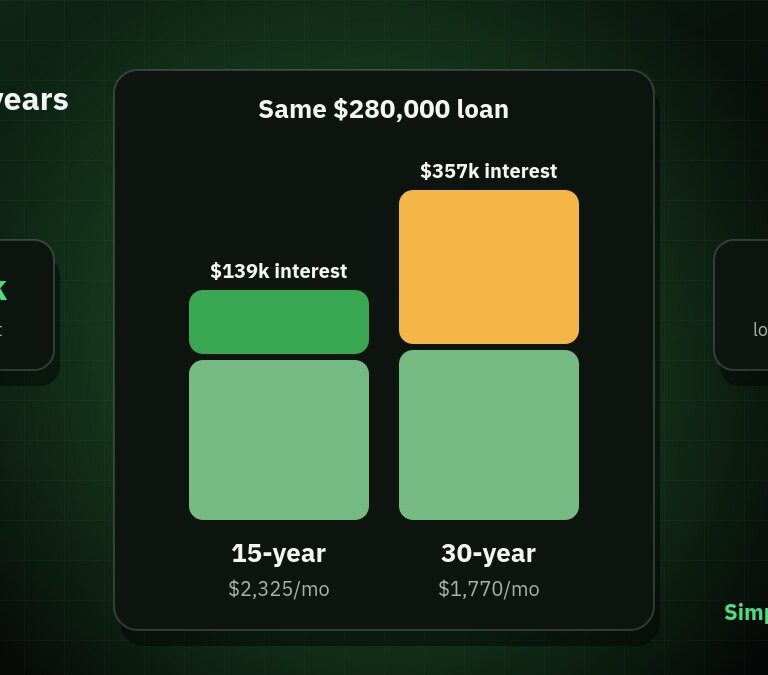
For our example, P = $280,000, r = 6.5% ÷ 12 = 0.5417%, and n = 30 × 12 = 360. Plugging these in gives a principal and interest payment of $1,769.79 per month.
In the first month, $1,516.67 of that payment is interest and only $253.12 goes toward principal. Over time the balance shrinks, so more of each payment pays down the loan. This is called amortization.
Step 3: Add property tax and insurance
Divide your yearly costs by 12 and add them to the payment:
- Property tax: $350,000 × 1.1% = $3,850 a year, or $320.83 a month.
- Home insurance: $1,500 a year, or $125 a month.
Rates vary a lot by location, so check your local property tax rate and get an insurance quote for the most accurate number.
Step 4: Add PMI if your down payment is under 20%
If you put down less than 20%, most conventional lenders require private mortgage insurance. It typically costs about 0.3% to 1.5% of the loan amount per year. For example, with 10% down on the same home, you would borrow $315,000, and PMI at 0.5% would add about $131 a month. You can usually remove PMI once you reach 20% equity.
Putting it all together
| Part of payment | Monthly cost |
|---|---|
| Principal and interest | $1,769.79 |
| Property tax | $320.83 |
| Home insurance | $125.00 |
| PMI (20% down) | $0.00 |
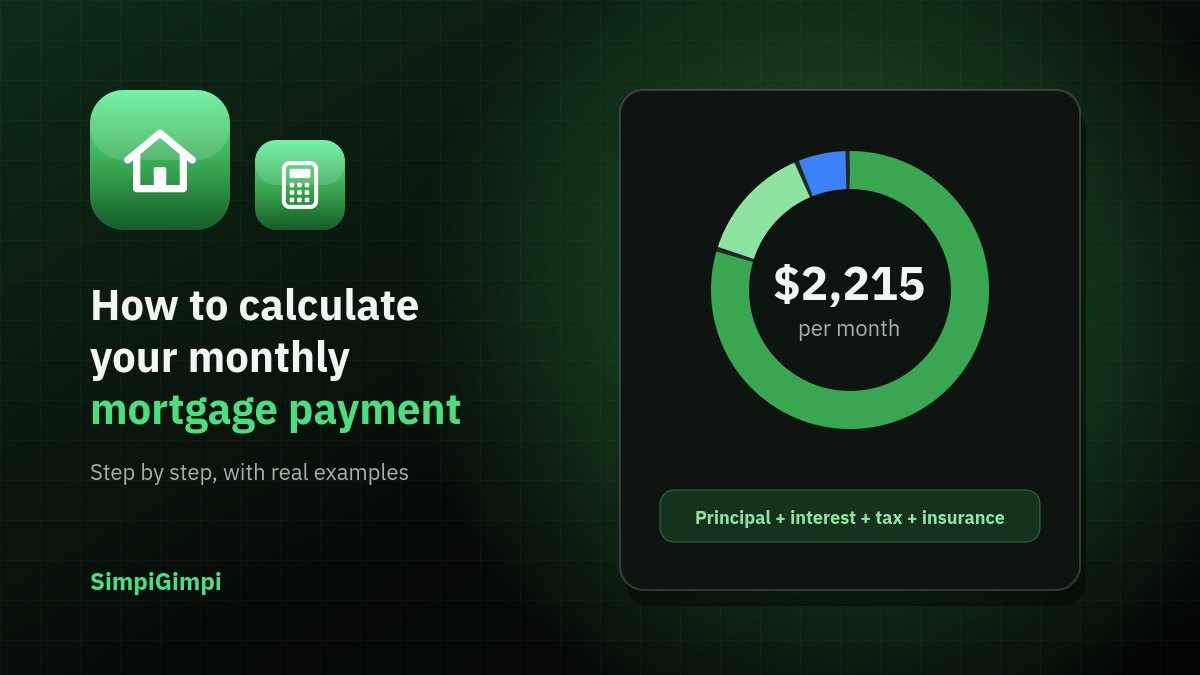
| Total monthly payment | $2,215.62 |
How the interest rate changes your payment
Even a small change in rate makes a big difference over 30 years. Here is the principal and interest payment on the same $280,000 loan:
| Interest rate | Monthly P&I | Total interest over 30 years |
|---|---|---|
| 5.5% | $1,589.81 | $292,331 |
| 6.0% | $1,678.74 | $324,347 |
| 6.5% | $1,769.79 | $357,125 |
| 7.0% | $1,862.85 | $390,625 |
| 7.5% | $1,957.80 | $424,808 |
Tips to lower your monthly payment
- Make a larger down payment to borrow less and avoid PMI.
- Improve your credit score before applying to qualify for a better rate.
- Compare offers from several lenders.
- Ask about property tax exemptions you may qualify for.
- Pay a little extra toward principal to save interest over time.
Skip the math with our free calculator
You do not need to do these calculations by hand. Our free Mortgage Calculator works out your full monthly payment, total interest, and a complete amortization schedule in seconds. It runs in your browser, so your numbers stay private.
This article is for general information only and is not financial advice. Your actual payment will depend on your lender, rate, and location.