
Choosing between a 15-year and a 30-year mortgage is one of the biggest decisions in buying a home. One gives you a lower monthly payment; the other can save you a six-figure sum in interest. Here is how to compare them, with real numbers.
The side-by-side comparison
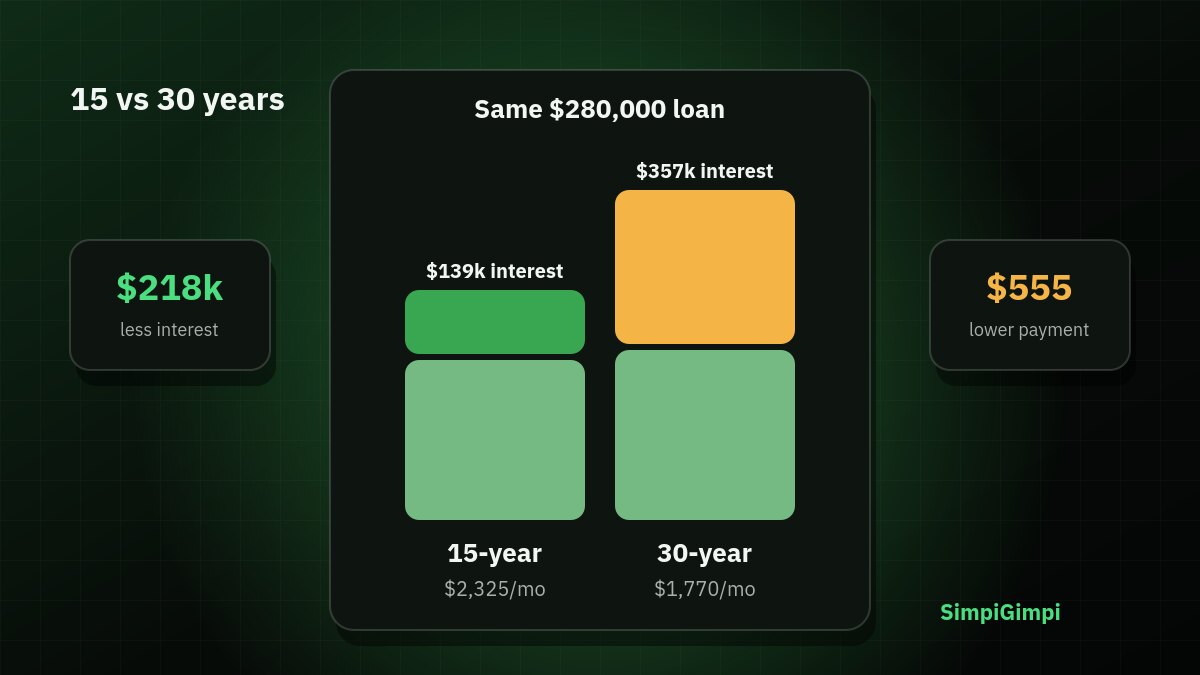
Here is the same $280,000 loan with typical example rates. Fifteen-year loans usually come with lower interest rates than 30-year loans.
| 15-year at 5.75% | 30-year at 6.5% | |
|---|---|---|
| Monthly principal & interest | $2,325.15 | $1,769.79 |
| Total interest paid | $138,527 | $357,125 |
| Total of all payments | $418,527 | $637,125 |
| Loan balance after 5 years | $211,822 | $262,111 |
After five years, the 15-year borrower owes about $50,000 less than the 30-year borrower, because a much larger share of each payment goes toward principal.
Why the 15-year mortgage saves so much
Two things work together. First, you pay interest for half as long. Second, lenders usually offer a lower rate on shorter loans because there is less risk for them. Even at the same 6.5% rate, a 15-year loan would cost $159,038 in interest, still almost $200,000 less than the 30-year loan.
Pros and cons of a 30-year mortgage
- Lower monthly payment, leaving more room in your budget for savings, emergencies, or other goals.
- Easier to qualify, because lenders look at how your payment compares to your income.
- More flexibility: you can still make extra payments when you can afford them.
- Much higher total interest over the life of the loan.
- Slower equity growth in the early years.
Pros and cons of a 15-year mortgage
- Huge interest savings and a lower interest rate.
- Faster equity and a home that is paid off in half the time.
- Higher monthly payment, which can strain your budget.
- Less flexibility if your income drops or expenses rise.
A middle path: a 30-year loan with extra payments
If you want flexibility but still want to save interest, you can take a 30-year loan and pay extra each month. Adding just $200 a month to the 30-year example above pays the loan off in about 22 years and 9 months and saves roughly $101,000 in interest. If money gets tight, you can simply go back to the regular payment.
Which one is right for you?
A 15-year mortgage usually makes sense if the higher payment fits comfortably in your budget and you already have an emergency fund and retirement savings on track. A 30-year mortgage is often the better choice if you want a lower payment, need flexibility, or have higher-priority uses for your money.
- Can you afford the 15-year payment without stretching your budget?
- Do you have three to six months of expenses saved for emergencies?
- How long do you plan to stay in the home?
- Would you rather lock in savings, or keep monthly cash free?
Compare both options in seconds
Try both terms in our free Mortgage Calculator. Switch the loan term between 15 and 30 years to see your monthly payment, total interest, and the full amortization schedule side by side.
Rates in this article are examples for illustration only. This is general information, not financial advice; speak with a lender or financial professional about your situation.